
Why per-seat pricing loses energy workforce tenders
When a seat-based quote and a risk-transfer quote land at the same total, procurement picks the second one — not because it's cheaper, but because it maps to how the buyer budgets, scores, and defends risk. The seat vendor loses on legibility, not price.
Ayleen Sadvakassova · EOR platform GTM for Energy mandates · 29 June 2026
When a seat-based quote and a risk-transfer quote land at the same total, procurement picks the second one. Not because it's cheaper — because it maps to how the buyer budgets, scores, and defends risk internally. The seat-based vendor loses on legibility, not price, and usually misreads the loss as a pricing problem.
What procurement is actually buying
Energy buyers in offshore wind, HVDC, oil and gas, and heavy industry don't budget against the number of people logging into a platform. They budget against identified project risks: misclassification exposure, offshore and site liability, localization penalties, work-permit failures, labor-law violations, schedule slippage, and audit exposure. Each risk ties to a specific contract, work package, role, site, and jurisdiction.
That produces one hard consequence for per-seat vendors: in an energy workforce mandate, a 200-seat quote and a 40-seat quote can represent identical risk coverage. Seat count is noise against a risk-based budget envelope. The buyer is moving a defined share of a defined risk off its own balance sheet — not buying software access.
How the buyer builds the budget
In one six-country QA/QC inspection framework (anonymized, figures rounded), the buyer didn't start with headcount. It started with work packages: foundation fabrication in the UAE, export cable production in Korea, WTG inspection in Denmark, offshore substation work in Thailand, jacket fabrication in Norway, electrical components in Brazil. Each package had a location, fabrication window, role profile, shift requirement, and compliance exposure.
That schedule was the buyer's risk register in commercial form. It told procurement, finance, legal, and project leadership where schedule could slip, where liability could land, and where assurance had to be bought. A winning quote had to map to that risk map. A role-by-country rate card did. A per-seat quote forced procurement to translate software access into risk coverage first.
Same total, different deal
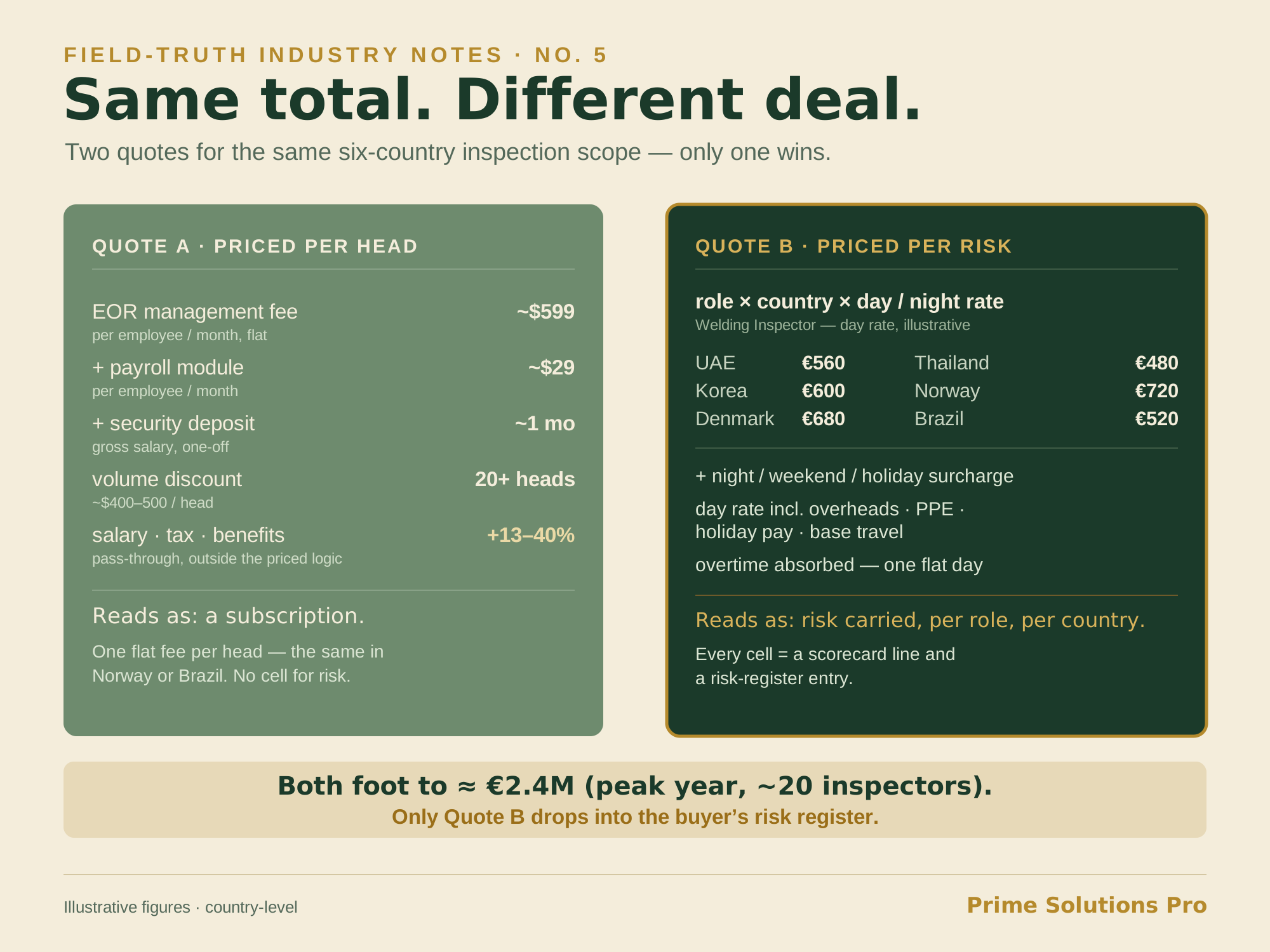
Two bids landed within a rounding error of each other on total annual value.
The first was a volume-discounted seat model across six countries: more users, a larger discount band, one blended platform fee. Its numbers answered a single question — what does the platform cost? Public pricing from major EOR platforms has historically anchored around a flat management fee in the ~$500–600 per-employee-per-month range, a payroll module near $29, a deposit of roughly one month's gross, and discounts negotiated at 20-plus heads — with salary, employer taxes, and statutory benefits excluded, typically adding 13–40% on gross. The defining problem is the flat per-head fee: a welding inspector on a 24-hour shift pattern in Norway and a document controller in Brazil sit under the same logic. Nothing in the structure moves with role risk, country risk, statutory regime, shift pattern, site exposure, permit complexity, or indemnity carried. Procurement reads it as a per-user subscription. There is no clean cell for risk carried.
The second bid was priced as risk carried — per role, per country, per shift pattern, with explicit surcharge logic and named responsibility for misclassification and cross-border compliance findings. It answered a different question: what exposure is this vendor carrying, where, and under what conditions? The buyer's own rate schedule was indexed to role, country, unit, and shift. For a Welding Inspector, day rates ran roughly: UAE €560, Korea €600, Denmark €680, Thailand €480, Norway €720, Brazil €520. Night, weekend, and public-holiday surcharges were each calculated separately as a percentage of the hourly rate. Day rates were inclusive of site establishment, overheads, statutory deductions, holiday pay, PPE, tools, and base-location travel; overtime was absorbed into the rate, not passed back to the client.
Repeat that block for every qualification the program needs — Coating Inspector, NDT Operator, Inspector Outfitting, Dimensional Control Inspector, Inspector WTG, Site Lead QA/QC — and the rate card becomes the risk register. Every cell states the price of assurance for a specific role, in a specific country, under a specific work pattern. Procurement reads: we pay this much, for this role, in this country, on this shift, with this exposure covered.
Procurement chose the structure it could defend to finance, legal, audit, and the board. The seat vendor didn't lose on price. It lost because its number couldn't be read as risk — so it was read as tooling.
How one day rate is built
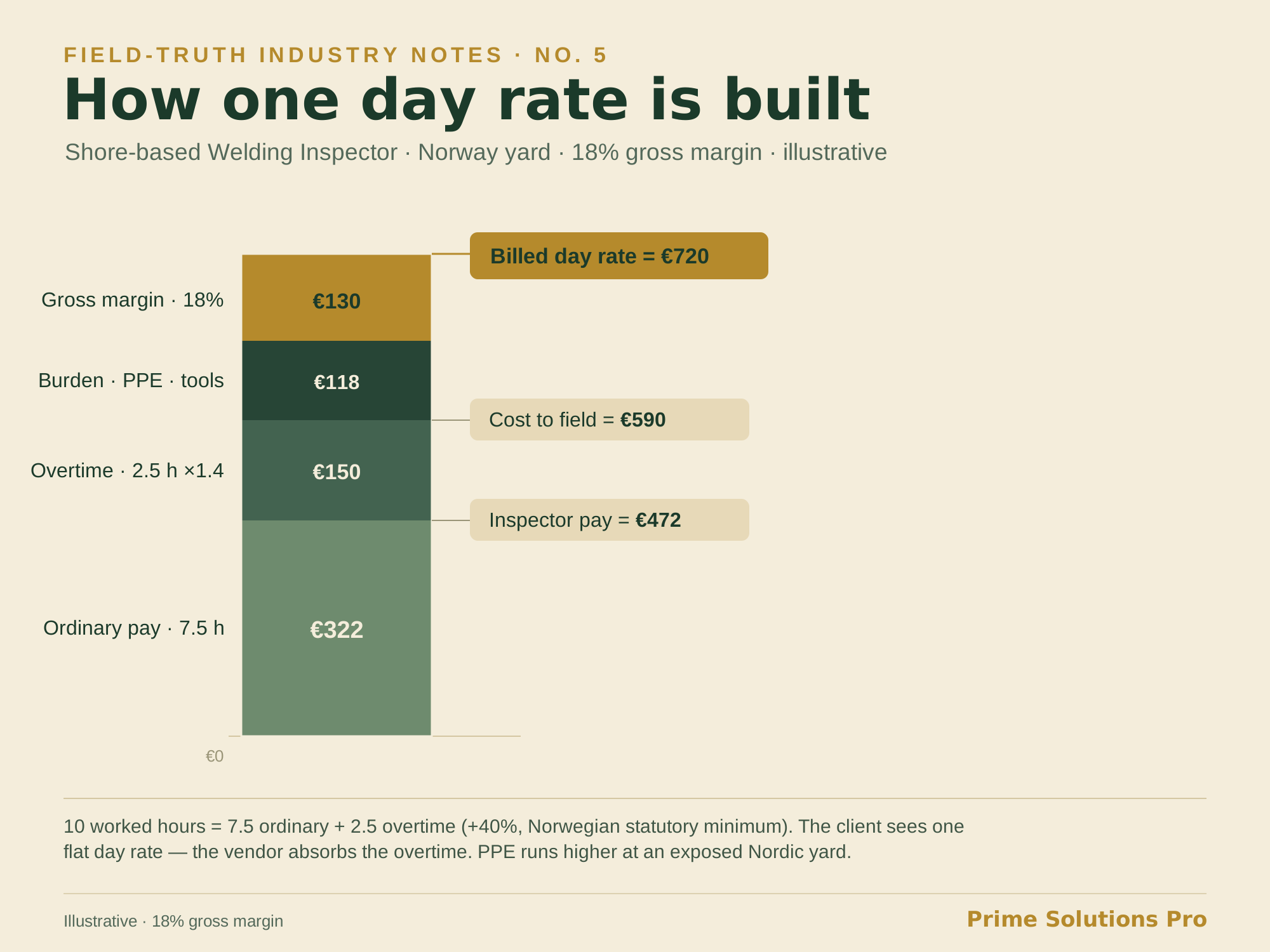
Tenders like this ask for a cost breakdown, not just a number. A seat model has little build-up to show. A day-rate model does.
Take a shore-based Welding Inspector at a Norway yard, at 18% gross margin. The contracted day is 7.5 ordinary hours; the yard pattern runs about 10 worked hours, so each day carries overtime through a structured averaging arrangement.
- Ordinary pay: 7.5h × ~€43 = €322
- Overtime: 2.5h × €43 × 1.40 = €150
- Inspector pay for the day: €472
- Employer burden, PPE, tools, holiday pay at ~25%: €118
- Cost to field the inspector: €590
- Gross margin at 18%: €130
- Billed day rate: €720
The client sees one flat day rate; the vendor absorbs the overtime logic. Run the same build-up in Thailand and the number resolves lower — not because the margin changed, but because base pay, statutory burden, overtime rules, work pattern, and field conditions differ by country. That's exactly the variation a flat per-head fee can't express.
Where seat contracts break
To be fair, seats aren't wrong everywhere. For genuinely undifferentiated headcount, a per-user fee is simple and easy to compare. Energy fabrication programs are never that. Each failure mode below has the same root cause: the vendor's metric tracks access while the buyer tracks risk reduction per project and jurisdiction.
Metric density collapse. A large share of licensed users on an industrial program never log in — field crews, night-shift inspectors, rotating contractors. The buyer feels it's paying for empty seats, not coverage.
Role asymmetry. The riskiest roles are often the fewest. One site lead or specialist inspector on a critical weld carries more schedule and liability exposure than dozens of low-risk users. Per-seat pricing makes the highest-risk roles look too cheap and the lowest-risk ones too expensive.
Jurisdictional blind spots. A flat seat rate treats Norway, Korea, Thailand, Brazil, Denmark, and the UAE as one commercial object. Labor rules, permit regimes, localization, offshore liability, and employer burden all move by country. A blended seat quote silently misprices that.
Tender scoring misalignment. Energy RFPs rarely award points for seat-volume discounts. They score commercial completeness, implementation concept, supplier quality, local-entity coverage, compliance-answer quality, indemnity, and risk assessment. A SaaS EOR vendor can win on price and still lose the part of the scorecard that decides trust.
Audit-trail weakness. Legal, finance, and audit have to explain the selection. "We bought 200 seats" is weak. "We paid X to cover Y risk across these jurisdictions, roles, and work packages" is defensible. Risk-priced line items create that trail automatically.
Misclassification underpricing. Misclassification penalties are non-linear. One misclassified worker in a high-risk jurisdiction can generate exposure many multiples of that person's seat fee.
(That's not the whole list. Renewal friction, negotiation-framing traps, contract rigidity, and the sales-enablement gap are failure modes of their own — Note 06.)
What a risk-transfer structure looks like
The fix isn't a discount. It's a change of unit. Replace user count with three linked elements.
A base fee per project, asset, or jurisdiction covers defined compliance and payroll scope across named legal entities, sites, work packages, and countries — so the buyer can attach it to a project budget instead of a generic software line.
Variable components pegged to risk drivers follow actual exposure: worker classification, country, role criticality, shift pattern, site access, permit complexity, localization rules, statutory burden, and offshore or hazardous-location exposure. The point isn't to make pricing complicated — it's to make it legible.
Explicit indemnity and outcome clauses state what the vendor carries, where responsibility starts and stops, and how findings are handled: misclassification, compliance failures, permit issues, payroll errors, localization breaches, delayed mobilization.
The buyer needs to be able to write one sentence internally: we pay X for the vendor to carry Y share of workforce compliance and project-timeline risk on this scope. A platform that insists on active-user count as its pricing axis can't fit into that sentence. It stays a tool, not a risk partner.
Why vendors rarely make the change
Almost no one writes this down because it's uncomfortable. Lost-tender data rarely reaches pricing teams. Energy procurement scorecards rarely shape SaaS packaging. And admitting that per-seat pricing loses project-based mandates challenges the model investors tend to prefer. So the public positioning stays generic — flexible pricing, usage-based models, enterprise discounts, global compliance coverage — and the tender failure keeps showing up anyway. The product may be strong, the total competitive, the sales team convinced it answered the brief, and the quote still can't be defended as risk transfer.
Energy workforce deals sit at the intersection of SaaS and professional services. The buyer doesn't only care whether the platform works. It cares whether the vendor can carry a defined share of risk across a defined project environment.
Seat count is what you charge for. Risk carried is what they're buying. When those become the same sentence, you stop losing deals you should win.
If you price these mandates — does this match what you're seeing on your side of the table?
Get the Monday note in your inbox
Published every Monday on LinkedIn. Subscribe there and LinkedIn will deliver each new note straight to your inbox.