
Six plays that win energy tenders with no case study
I didn't have a case study. I had a method — and it won exclusive HVDC and offshore wind mandates, including a nine-figure EOR scope, before the precedent existed. Here are the six plays.
Ayleen Sadvakassova · EOR platform GTM for Energy mandates · 6 July 2026
Europe's grid operators are lining up some of the largest HVDC and offshore wind tenders this market has seen. France alone is taking around 10 GW to auction.
Every supplier chasing that work will reach for the same page: the logo wall.
But in first-of-kind energy scopes, the buyer's problem is not always, "Who has done this before?" Sometimes the real question is, "Who can build the operating model when the market has no precedent yet?"
I have won exclusive offshore wind operation, maintenance and installation scopes, plus a nine-figure EOR HVDC QA/QC inspection scope, without a case study to hide behind. Not from the sidelines. By helping design the solution when the market said there was no solution yet. No local talent pipeline. No delivery precedent. No case study to point to. Just methodology, structure, and the ability to make risk legible to the buyer.
Here's the playbook.
I entered offshore wind in Singapore in 2019, before several APAC delivery models had matured. Across developers and TSOs including Ørsted, WPD, CIP, Northland Power, RWE and TenneT, the same pattern kept appearing: the market needed delivery structures before some suppliers had the case studies to prove them.
What follows is the structure. Six plays. Every one was tested in live delivery, not in a pitch deck.
1. Arrive before the problem is visible.
I was engaged from the 2019 Singapore fabrication phase, before the Taiwan offshore wind workforce challenge was on most of the market's radar. By the time offshore installation and commissioning became a tender, I was not only responding to the scope. I had helped define it. That partnership grew well beyond the first project.
You do not win a tender in the bid window. You win it eighteen months earlier, in the room where the problem is still being named.
Seller lesson: if the buyer has to educate you during the tender, you are already late.
2. When the talent does not exist, build it.
Taiwan did not yet have the offshore wind workforce the programme required. Some GWO modules were still unavailable locally. BOSIET routes were limited. The local offshore personnel base was not deep enough for the scope.
Waiting for the market to catch up was not a plan.
So I went around it in the tender delivery concept: sourcing non-traditional talent with the aptitude the job actually demands, including military leavers and high-rise window cleaners, people with the discipline and height-working instinct you cannot teach, then routing them through Thailand and Malaysia for the certification modules Taiwan could not yet deliver.
The result was a fully exclusive scope to attract, train, certify and retain 14 offshore technicians, fully GWO and OGUK compliant, on a programme near 1 GW.
In global offshore wind tenders I widened who could be mobilised — women, veterans, displaced fishing communities, under-tapped STEM talent — through up-skilling and re-skilling programmes.
If the pipeline does not exist, the bid that builds one wins.
Seller lesson: when supply does not exist, the winning bid is the one that explains how supply will be created, certified, governed and retained.
3. Turn the regulation nobody else will touch into your moat.
The offshore rules in Taiwan were as untested as the talent pool.
I helped establish the advance approval protocols for 14/14 offshore rotation schedules for an operations team based onshore, taking the case through two appeal processes with the Taiwan government. That unlock was not a compliance checkbox. It was the scope.
The market has matured since. 28/28 rotations are possible now. At the time, someone had to be first.
The regulatory barrier everyone else flags as a risk is the one you win on if you own it.
Seller lesson: in emerging markets, regulation is not only a constraint. It can become the proof that you understand the operating environment better than the supplier selling generic delivery.
4. Own the outcome no one else will touch.
When COVID-19 closed Taiwan's borders, more than twenty of the programme's workforce service providers declared mobilisation impossible.
I treated it as a stakeholder problem, not a travel problem. I worked with Chamber of Commerce coalitions and regulators in parallel to secure government border exemptions for offshore wind professionals, and proved the Gold Card route by securing my own in days.
The outcome, announced in August 2020, was a fully exclusive two-year EOR scope for the OSS commissioning mobilisation. The client later moved consultants from other agencies to operate under our coordination.
You do not earn that by managing a process. You earn it by owning the outcome everyone else called impossible.
"Ayleen secured critical government permits during COVID, work that no one else was able to do. She took complete ownership of the challenge. This level of trust came from demonstrating that she doesn't just manage processes, she owns outcomes." — Full recommendation on LinkedIn
Seller lesson: buyers do not remember who followed the process. They remember who made the outcome possible when the process broke.
5. Sell the operating model, not the brochure.
Later, a global Tier-1 developer ran a global preferred-supplier tender. A panel, not a single scope. No case study could have answered it.
I secured a seat by showing an operating model instead: exactly how I would close the offshore talent gap and hold continuity through sourcing, screening, certification, mobilisation, compliance, replacement, reporting and escalation, with named owners and real response times.
I used the same method to win a nine-figure HVDC QA/QC EOR mandate with a European TSO, without a single HVDC QA/QC scope on the books globally.
An auditable process beats a better brochure every time.
Seller lesson: when the buyer cannot buy certainty, they buy the clearest operating model for controlling uncertainty.
6. Make personal proof transferable.
In 2023, I moved to Taiwan and joined another agency. Within twelve months, I secured offshore MSAs with three major developers and their key EPCs.
Again, there was no in-country or global track record carrying the sale. What transferred was the method: market knowledge, buyer trust, compliance logic, offshore mobilisation structure and the ability to explain delivery before the delivery machine existed.
A case study proves what happened once. A method proves how you will repeat it.
Seller lesson: the strongest proof is not always a logo. Sometimes it is the operator who can show the buyer exactly how the work will be made possible.
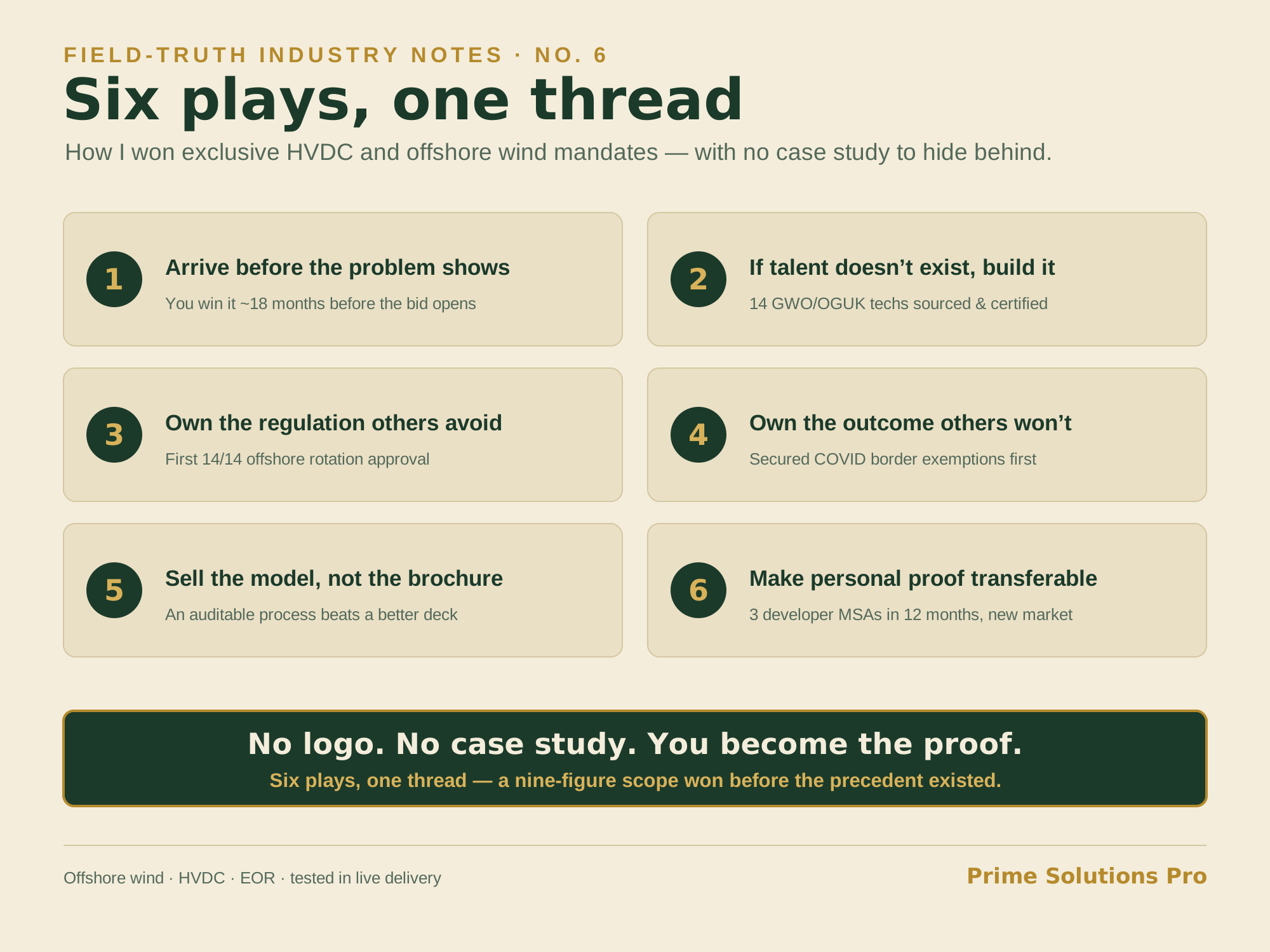
Six plays, one thread
None of it came from a logo. It came from arriving early, engineering supply where there was none, owning the regulation, owning the outcome, and selling a process a buyer could audit.
That is how you win a nine-figure scope with no case study. You become the proof.
If you are selling into HVDC, offshore wind, EOR or energy field-service mandates, the question is not only whether you have done it before. The question is whether your method is strong enough for a buyer to trust before the case study exists.
Get the Monday note in your inbox
Published every Monday on LinkedIn. Subscribe there and LinkedIn will deliver each new note straight to your inbox.