
Global Workforce Mobilization Trends: from Energy Transition to Energy Security
When sustainability gets hard, it gets physical. Why the workforce — not the office — is becoming national infrastructure.
Ayleen Sadvakassova · EOR platform GTM for Energy mandates · 22 June 2026
Something has shifted in how energy gets talked about, and it happened fast once real shocks started landing.
After the war in Ukraine, many countries learned the same lesson at the same time: energy is not a "sector." It is a dependency. When supply is threatened, everything else becomes negotiable.
And when chokepoints flare up, like the Strait of Hormuz, the lesson gets sharper again. You do not need to be an energy analyst to understand the risk. If a route that carries a meaningful share of the world's oil and LNG becomes unstable, prices move, insurers move, shipping schedules move, and governments move. Ordinary businesses feel it within weeks.
Two shocks, one turn
War in Ukraine and the Strait of Hormuz reframed renewables — from climate goodwill to national security.
There is a second force pushing in the same direction, and it is not geopolitical. It is demand.
AI is not an app. It is infrastructure. It runs on data centers, cooling, and a lot of electricity. In some places, bitcoin mining and other compute-heavy loads add another layer: fast, mobile demand that can hit a grid node hard and trigger political attention overnight.
Energy sovereignty doesn't care about ESG slogans or Diversity & Inclusivity pledges — it cares about who can build it, and who can staff it, on time. It is a hard story about security, capacity, and delivery.
In more and more capitals, "energy sovereignty" is quietly displacing "energy transition." Grid resilience and critical minerals are being funded like defense, not virtue. Renewables, storage, interconnection, and domestic fabrication are being treated as national infrastructure.
Most commentary stops there, at the level of politics and capital. Who funds it. Who regulates it. Who controls the materials.
But if you are responsible for delivery, a different question decides whether any of it gets built: Who physically builds it, and who can staff it compliantly.
When sustainability gets hard, it gets physical
Here is the field-truth. Every item on the hard-energy list is first a labour and compliance problem, not just an engineering one. Even perfect engineering does not matter if the people who install, commission, inspect, and operate the asset cannot be mobilised legally and on time.
The bottleneck the macro keeps missing
Grid connection and power upgrades. A country can approve wind farms, solar farms, and data centers — but if the grid can't take the load, nothing moves.
Electrification pushes demand up. AI pushes demand up. New industrial policy pushes demand up. Renewables add variability that requires more transmission, smarter balancing, and more resilient infrastructure.
This is not theoretical:
- Germany is rebuilding major parts of its grid backbone with new high-voltage corridors.
- Australia is connecting and reinforcing its grid with large projects, including Marinus Link.
- In the USA, HVDC is scaling fast, often framed as a domestic build and supply-chain play.
- In the Middle East, some markets are building quickly, others are stalling, often based on permitting, local capacity, and execution readiness.
If you are not close to this world, "global grid upgrades" sounds like equipment and civil works. In reality, it is mobilisation:
- finding specialist crews who are often scarce in-country
- clearing people onto sites with strict safety and access rules
- making sure the right certificates are accepted for that scope
- solving immigration, payroll setup, tax, and social security before anyone touches equipment
Grid projects do not slip because a cable is hard to manufacture. They slip because the right people do not arrive at the right time, with the right paperwork, under the right legal structure, with the right liability coverage, in a country that may already be short of the exact crews required. The grid won't self-assemble. The crews won't self-mobilise.
Regional HVDC interconnectors. Energy sovereignty in practice means wiring regions together so no single supplier can hold a country hostage. That is why HVDC interconnectors matter. They turn "we have energy" into "we can move energy, reliably, at scale," which becomes critical when supply chains, geopolitics, and demand are all unstable at once.
The scale marker in APAC is the Australia–Asia Power Link and the wider ASEAN Power Grid, with roughly 4,300 km of subsea cable ambition. Europe is the most active region for cross-border HVDC, with the UK as a central hub and the North Sea as a primary corridor.
Now the line that matters operationally: a single interconnector can cross 5 to 15 legal regimes before a local entity even exists. That is not a legal footnote. That is the build.
Because the physical reality behind one interconnector often looks like this:
- the programme runs across multiple jurisdictions
- the contractors and suppliers are distributed, and the work packages move
- fabrication and staging spread across dozens of yards, across multiple countries and regions, each with its own rules, sponsors, access standards, and liability terms
- the "right to work" rules change country by country, and sometimes project by project
- the yard sets site access and HSE requirements, not your procurement deck
- one compliance miss can stop an entire workstream at the worst possible moment
The steel is not the hardest part. The hardest part is clearance.
Here is what "clearance" looks like in real life. A commissioning crew lands, but the yard rejects two people because the medical is valid in country A, not accepted in country B. The sponsor cannot amend fast. Site access badges do not get issued. The vessel window holds for 72 hours, then moves. The schedule slips, not because the equipment is missing, but because the people are not allowed through the gate.
Renewables are not "soft" anymore. Offshore wind and onshore build-out are no longer sold on climate logic alone. They are security infrastructure now, which means tighter timelines, tighter rules, and less tolerance for delays.
Here are three examples from places I know directly:
France (where I live now, going through naturalization). After Ukraine, Europe stopped treating energy imports as a default. France moved fast. On 12 June 2026 it opened AO10, its biggest offshore wind tender yet: 10 GW, eleven projects, floating and fixed-bottom off Normandy, Brittany, the Atlantic and the Mediterranean. Then Hormuz hit, prices spiked and routes wobbled. That is when "energy sovereignty" stops being a slogan and becomes an operating requirement.
Kazakhstan (where I was born and raised). The war rerouted Eurasia. Kazakh crude that flowed north through Russia now moves west, across the Caspian into Baku–Tbilisi–Ceyhan, around both Russia and Hormuz. Routes shift, risk gets repriced, infrastructure follows. Same logic on power: Mirny (1 GW wind + storage, $1.2bn TotalEnergies FID) and Hyrasia One ($50bn green-hydrogen mega-project, 40 GW feeding 20 GW of electrolysis) are not just energy projects, they are resilience projects. And they ship only if you can mobilise the right crews into a thin local workforce pipeline.
China (where I sold workforce solutions) and Taiwan (7+ years in offshore wind). China never bought the West's "soft-era" sustainability ideology. It built renewables and HVDC out of hard pragmatism: energy security, industrial dominance, supply-chain control. And it won. Clean power just passed 51% of installed capacity. Wind and solar alone generate over 2,000 TWh, close to half of all US electricity, moved on the largest ultra-high-voltage grid ever built. The point is not politics. It is capacity: China resets the global baseline for what "fast" means.
Taiwan's offshore wind and broader renewables push isn't about stat-pack headlines like "3–4 million households." It's about keeping semiconductor fabs and global tech players — Google's data centers today, NVIDIA's soon — online. Nvidia and Google aren't buying renewables because they love climate. They're buying them because chip fabs and AI data centers burn electricity so fast that renewables are the only way to keep the lights on.
Now the part most non-operators miss. Offshore wind looks like one industry from a distance. Up close, it is a different compliance system country by country. Installation is not commissioning. Commissioning is not O&M. Work patterns shift too: 4/4, 2/2, 12/2, 6/7, 5/7 etc. That is not just scheduling. It changes what is legal, what is insurable, what is safe, and what can be sponsored.
Then there is the certification stack. A "qualified offshore wind tech" is not one universal profile. Requirements vary by project, contractor, port, and country.
Field-Truth case: Half my OSS offshore installation team in Taiwan failed the OEUK ERT fitness test during Covid-19. If you don't know: OEUK is the UK industry body (formerly OGUK) that sets offshore medical standards. For ERT members, there's a fitness test called the Chester Step Test — you step up and down on a 30 cm platform at a metronome pace that gets faster every 2 minutes. They calculate your VO₂ max, your aerobic fitness level. Standard OEUK ERT pass is ≥ 32–34 ml O₂/kg/min. In Taiwan (specifically, on this project), the sponsor bumped it to ≥ 38 ml O₂/kg/min — close to professional sportsman level. I didn't see the numbers until mobilisation, because there was only one hospital in the region with one doctor in Taichung to get this OEUK certification. The steel was on the barge. The vessel window held for 72 hours. I called the team personally. I've trained fitness and yoga in the past, so I shared simple breathing practices I believed could help. Not a lecture. Just a call. Just a technique. All of them got through in the end.
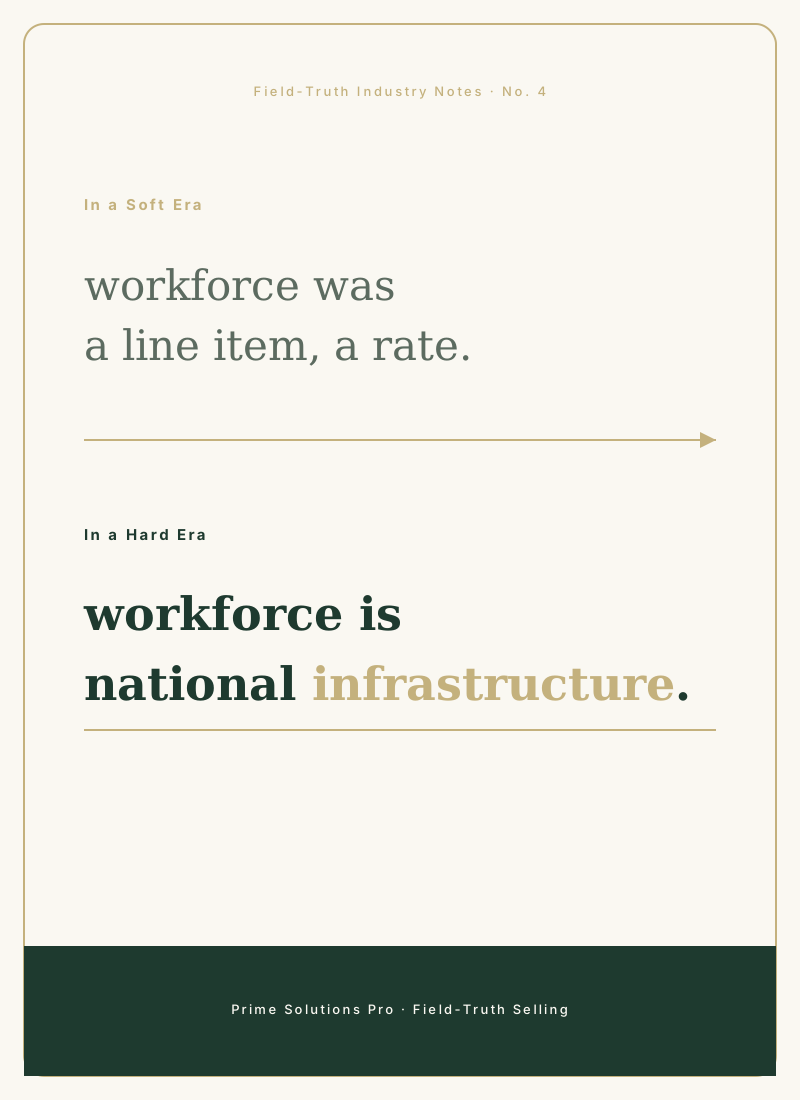
The pattern: in a hard era, workforce is infrastructure
Notice what grid upgrades, AI-driven load growth, HVDC links, and renewables now share. The harder the era, the more the bottleneck moves away from money and policy, which are abundant, and toward crews and compliance, which are not.
And it keeps coming back to the same benchmark: a single interconnector can cross 5 to 15 legal regimes before a local entity even exists. That is the delivery environment.
The supplier who can field compliant crews across hard jurisdictions is not a staffing vendor. They are part of the security architecture everyone else is only describing.
Here is the twist the cynics miss. The same leaders who wave away diversity as "soft" are about to lose the talent war to the ones who treat it as supply math. You cannot staff a gigawatt build from the same narrow pool everyone else is fishing — there aren't enough of them, and there never will be. Widening who can be mobilised — women, veterans, displaced fishing communities, under-tapped STEM, people a hearing impairment never should have screened out — isn't a pledge. Together with cross-border mobilisation, it is how you put enough cleared, qualified people through the gate on time. D&I as a press release is theatre. D&I as a mobilisation strategy is how the build gets staffed.
I have built this layer
I am not writing this as an observer. I have built and held multi-year exclusive workforce mandates across hard jurisdictions. I have stood up gigawatt-scale offshore delivery in markets without a local certification and offshore talent pipeline. I have designed global delivery models for offshore wind developers who needed one repeatable way to mobilise crews across regions, instead of rebuilding the answer on every deal.
None of that was corporate goodwill. It was structure, compliance, and crews, delivered.
Two messages, one for each side of the table
If you build and sell EOR or workforce platforms into energy. Stop calling your solution "global HR." Start calling it "risk removal in hard jurisdictions." If you can't prove you handle country-by-country, yard-by-yard, phase-by-phase, you're not selling energy — you're selling software.
If you own and award these mandates. You are not underpricing labour — you are underpricing supplier continuity. Buy delivery continuity, not day rate. Award to the supplier who stands when everything else shifts: when the yard tightens access, immigration changes, and the project expands across seven jurisdictions.
The close
The new rules are physical. They run on people cleared onto platforms, vessels, and converter stations — on time, compliant, in jurisdictions that don't forgive mistakes. That is the field truth. Soft analysis will not deliver it.
Get the Monday note in your inbox
Published every Monday on LinkedIn. Subscribe there and LinkedIn will deliver each new note straight to your inbox.